Why Context Is the Missing Layer in Modern AI Systems
Artificial intelligence has advanced quickly over the last decade. Models can summarize text, generate content, classify data, and even hold conversations. Yet despite this progress, many businesses experience the same frustration: AI outputs that look correct on the surface but fall apart when applied to real decisions.
The issue is not intelligence.
The issue is context.
Most AI systems still operate in isolation from the information that actually matters inside an organization—its documents, workflows, assumptions, historical decisions, and domain-specific logic. Without this grounding, AI becomes a guessing engine rather than a decision-support system.
This article explains why contextual understanding is essential, where traditional AI systems fail, and how contextual AI changes the way organizations extract value from their data.

The Real Problem With “Smart” AI
When companies adopt AI, they often expect it to “understand” their business. In practice, most systems are trained on generalized data and then lightly adapted to new environments.
This leads to common failures:
-
Answers that ignore internal policies or terminology
-
Recommendations that contradict historical decisions
-
Insights that overlook important constraints
-
Outputs that sound confident but lack relevance
The AI is not wrong—it is simply unaware of the environment it is operating in.
Just as a new employee needs onboarding, documentation, and background before making decisions, AI systems need structured access to organizational context.
What Context Actually Means in AI Systems
Context is often misunderstood as “more data.” In reality, context is relevant data, correctly connected.
In business environments, context includes:
-
Internal documents (SOPs, contracts, reports, manuals)
-
Domain-specific language and definitions
-
Historical decisions and exceptions
-
Data relationships across systems
-
User intent at the moment a question is asked
Contextual AI systems do not merely retrieve information. They understand how information relates, which pieces matter, and when they should be applied.
Why Document-Heavy Businesses Feel AI Pain the Most
Industries that rely heavily on documents tend to see the biggest gap between AI expectations and reality.
Examples include:
-
Finance and accounting teams managing policies, audits, and forecasts
-
Legal teams handling contracts and regulatory language
-
Healthcare organizations maintaining protocols and patient records
-
Operations teams working with SOPs, logs, and incident reports
In these environments, meaning is not just in the words—it is in the structure, references, and historical usage of those words.
A generic AI model may read a policy document, but without understanding how that policy has been interpreted in the past, its output remains shallow.
Contextual AI vs Traditional AI Workflows

Traditional AI workflows typically look like this:
-
User asks a question
-
Model generates an answer based on general training
-
Output is accepted or manually corrected
Contextual AI workflows are different:
-
User asks a question
-
System identifies relevant internal sources
-
Information is retrieved and cross-referenced
-
The model responds within known constraints
-
Output reflects real organizational knowledge
This difference is subtle but critical. One system guesses. The other reasons within boundaries.
Why Accuracy Alone Is Not Enough
Many AI tools are evaluated on accuracy metrics. While accuracy matters, it does not guarantee usefulness.
A response can be factually correct and still be:
-
Incomplete
-
Misaligned with business rules
-
Based on outdated assumptions
-
Irrelevant to the user’s role
Contextual AI shifts the focus from “Is this answer correct?” to “Is this answer appropriate for this situation?”
That distinction is what separates experimental AI tools from production-ready systems.
How Context Reduces Risk and Improves Trust

One of the biggest barriers to AI adoption is trust. Users hesitate to rely on systems they cannot verify or explain.
Contextual AI improves trust by:
-
Grounding responses in identifiable sources
-
Aligning outputs with internal documentation
-
Reducing hallucinations and over-generalization
-
Making reasoning paths clearer
When users recognize their own data, language, and rules reflected in AI responses, confidence increases naturally.
Practical Use Cases Where Context Makes the Difference
Contextual AI is especially valuable in scenarios such as:
-
Answering employee questions using internal knowledge bases
-
Supporting analysts with document-aware insights
-
Assisting compliance teams with policy interpretation
-
Enabling faster onboarding through guided knowledge access
-
Improving decision support without replacing human judgment
In all of these cases, the AI does not replace expertise—it augments it.
Why “Plug-and-Play” AI Rarely Works
Many organizations try to deploy AI as a drop-in solution. They connect a tool, upload some files, and expect results.
This approach fails because context is not static. Documents evolve. Policies change. Business logic adapts.
Effective contextual AI systems are designed to:
-
Continuously ingest updated information
-
Preserve relationships between documents
-
Respect versioning and historical relevance
-
Adapt to different user roles and intents
Context is a living layer, not a one-time setup.
The Long-Term Value of Context-First AI
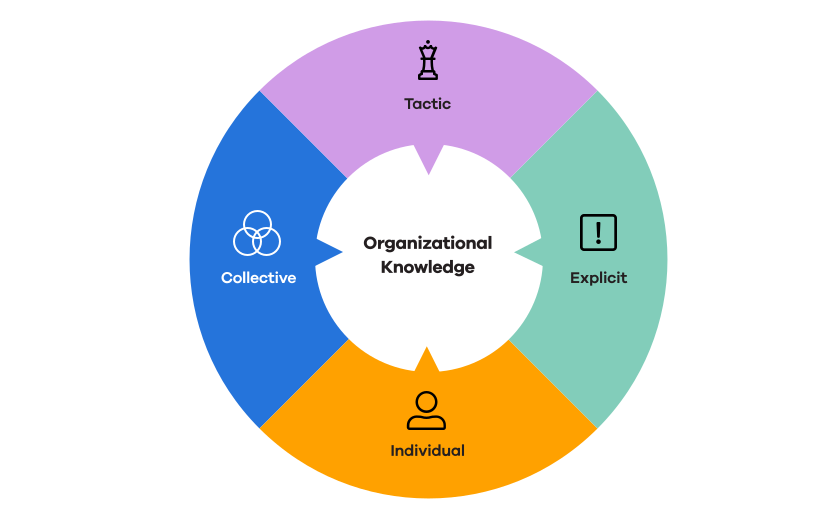
Organizations that invest in contextual AI are not just improving today’s workflows. They are building infrastructure for long-term intelligence.
Over time, these systems become:
-
Institutional memory repositories
-
Decision-support companions
-
Knowledge bridges between teams
-
Risk-reduction mechanisms
Rather than asking AI to “be smart,” they give it the environment needed to be useful.
Final Thoughts
AI systems do not fail because they lack capability. They fail because they lack understanding of the world they are placed in.
Contextual AI addresses this gap by grounding intelligence in real data, real documents, and real workflows. It moves AI from abstract reasoning to practical support.
For organizations serious about extracting value from AI—without sacrificing accuracy, trust, or control—context is not optional. It is the foundation.

Comments
Post a Comment